

Business expenses are categorized as either fixed or variable costs. You should identify your company’s fixed and variable expenses for accurate books. Learn the difference between fixed vs. variable costs to help with budgeting, pricing, and decision making.
Fixed vs. variable costs
You need both fixed and variable costs to run your business.
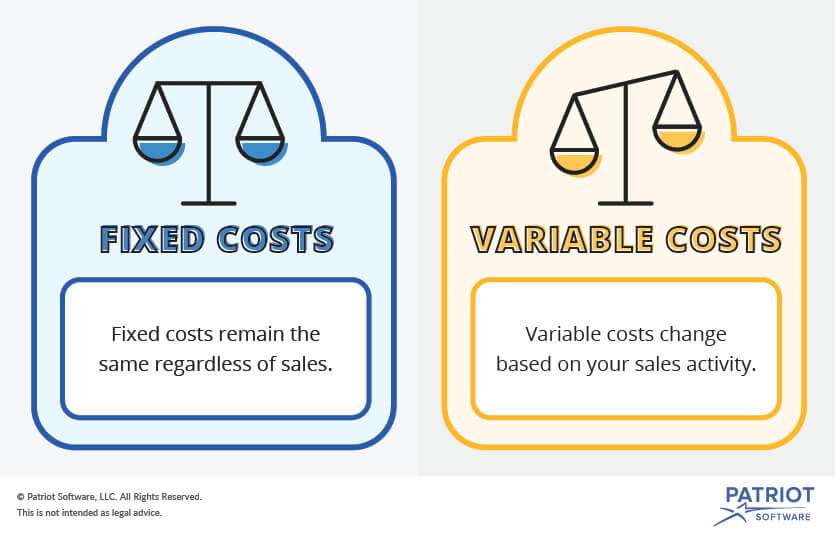
Fixed costsare expenses that remain the same, regardless of how many sales you make. Fixed costs are expenses you must pay to run your business. You will always have fixed costs, even if you don’t sell much. Generally, your fixed expenses will stay the same from month to month.
另一方面,variable costsfluctuate based on your sales activity. If sales are high, your variable costs increase. And if sales are low, your variable costs decrease. Variable expenses change from month to month.
Fixed and variable costs examples list
Understanding which of your expenses are fixed and which are variable is important. To help, take a look at these fixed and variable costs examples.
Here are a few examples of fixed costs you might have in your business:
- Rent
- Insurance
- Loan payments
For example, if you rent business space, you have a regularly recurring payment each month, regardless of how many sales you made. The amount is the same unless your lease agreement changes.
以下是您在您的业务中可以拥有的可变成本的示例:
- Direct materials
- Direct labor
- Commissions
Let’s say your employee earns commissions. The more they sell, the higher the amount you owe them. Their wages are a variable cost because they depend on sales.
Using fixed and variable costs in your pricing structure
You should have a healthyprofit margin成长为您的业务。减少费用后,利润率是您的业务收入。如果您的费用超过您的收入,您将获得负利润率。了解您的业务的总成本,以帮助您确定价格。
How to find your total costs
要找到您的业务总成本,您需要了解固定成本和可变成本。发现固定成本很简单,因为它们每个月都是相同的。但要找到您的总变量成本,您需要使用变量成本公式。
Variable cost formula
You need to know how many products you sold and the variable cost of each product to use the variable cost formula.
Total Variable Costs = Products Sold X Variable Cost Per Unit
Let’s say you sold 5,000 cell phone cases. It costs you $5 to make each case. Your total variable costs are $25,000.
寻找总成本
Once you know your fixed and variable costs, you can find your business’s total expenses. To find your total costs, simply add your fixed and variable expenses.
Total Costs = Fixed Costs + Variable Costs
However, you should also know how many variable and fixed costs you spend on each unit. This can help you set a fair price that results in a profit for you. Here is the total cost per unit formula.
Total Cost Per Unit = (Fixed Costs + Variable Costs) / Total Units Produced
For example, you have $5,000 in fixed costs and $3,000 in variable costs. You produced 4,000
Total Cost Per Unit = ($5,000 + $3,000) / 4,000
Total Cost Per Unit = $2
You spend $2 making each unit. You can use this information to set a price for each product.
Mixed costs
并非所有费用都是固定的或变量。一些费用可能具有固定和可变成本的方面。这种费用被称为混合,半变量或半固定成本。
混合成本是固定到某一个点。Then, they become variable.
Examples of mixed costs include salaried (fixed) workers who also receive commissions (variable) or work overtime (variable) and car expenses like a monthly lease (fixed) and gas (variable).
Let’s say an employee needs to work overtime as a result of increased sales. Because the overtime wages are due to a rise in sales, they are variable. But, the employee’s regular wages are fixed costs. This would make the employee’s total pay for that pay period (overtime and regular) a mixed cost.
Looking for an easy way to track your business’s fixed and variable costs? Patriot’s onlinevwin055 使用一个简单的系统,为非会计师制作,以简化费用跟踪。今天免费尝试!
This is not intended as legal advice; for more information, please点击这里。