

When a company makes money, it may decide to return a portion of cash to its shareholders. Depending on thebusiness structure, individuals may receive special payments from a business called distributions. Read on to learn what is distribution, types, and how distributions work.
Distribution Definition
A distribution is a company’s payment of cash, stock, or physical product to its shareholders. Distributions are allocations ofcapitaland income throughout the calendar year.
When a corporation earns profits, it can choose to reinvest funds in the business and pay portions of profits to its shareholders.
Shareholders can receive distributions on a regular basis, such as monthly, quarterly, or annually.
Shareholder distributions are common with pass-through entities, such as an S Corporation or limited liability company (LLC). Companies withpass-through taxationare not taxed directly. Instead, taxable company profits are passed through to shareholders.
Distributions vs. dividends
Distribution funds function similarly to stock dividends. But, how do dividends differ from distributions?
A dividend is a reward paid to shareholders for their investment in a company’s equity. Rewards typically come from the business’s net profits. ManyC Corporationsuse dividends.
A board of directors determines the dividend frequency and payout rate. Like distributions, you can issue dividends as cash payments, shares of stock, or other property.
Distributions are common for anS Corporation。有时合伙企业或有限责任公司s make distributions, too.
Although there are various payment options, distributions are normally given in the form of cash. A recipient of a cash distribution must treat the payout as a type of income. And, the recipient must report payouts to the IRS using specific forms. For, example S Corps must report income on Form K-1 to file abusiness tax return。
Distributions to shareholders are typically higher amounts than dividends (e.g., 10% per year).
Additional types of distributions
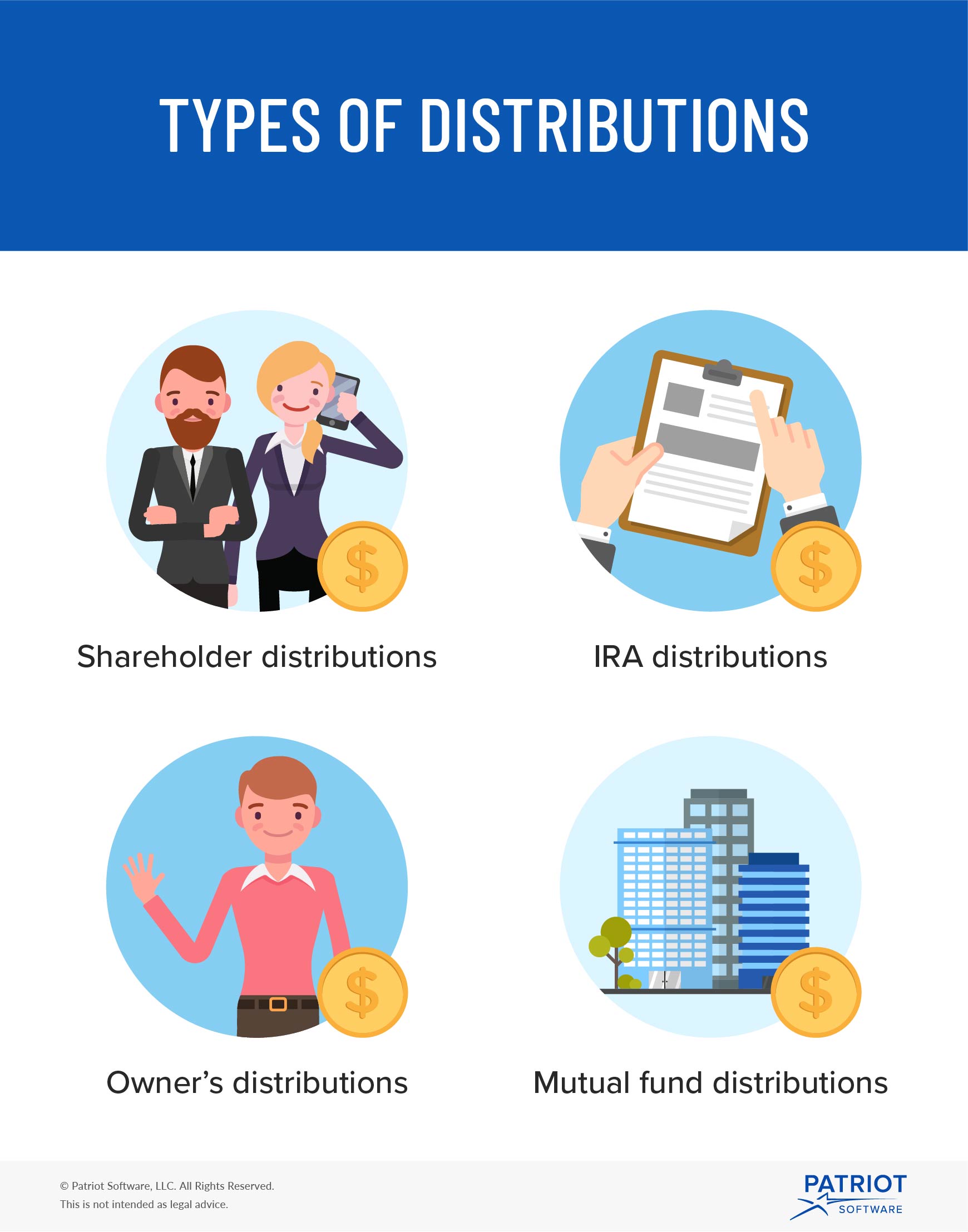
While a shareholder distribution refers to paying a shareholder stock, cash, or property, other types of distributions are also available to individuals. Additional types of distributions include owner’s distributions, individual retirement accounts (IRAs), and mutual fund distributions.
Owner’s distributions
Owner’s distributions are earnings an owner withdraws from their business. The amount of the distribution depends on the business’s profits.
Business owners may utilize distributions for personal use or place distributions in business accounts for future use.
Protocols for owner distributions may vary depending on the type of business structure (e.g., partnership).
IRA distributions
IRA distributions can include plans such as403(b) accountsor457 plans。Retirement account distributions fall into two categories:
- Distributions individuals take prior to age 59-and-a-half
- Distributions individuals take on or after turning 59-and-a-half
If an individual takes the distribution before turning 59-and-a-half, the distribution is subject to IRS penalties andordinary incometax.
Mutual fund distributions
A mutual fund company typically gives earnings and other types of payouts to investors or shareholders as distributions.
Mutual fund distributions are earnings from a fund’s operation. Unlike regular shareholder dividends, a mutual fund is required by law to pass profits back to investors or shareholders.
共同基金包括或类型的分布dinary dividends, qualified dividends, and capital gains. The way you tax the distribution depends on the type.
Distributions and payroll
Generally, shareholders of a pass-through entity who perform work for the business must be paid a “fair wage”, otherwise known asreasonable compensation。If a shareholder works for the company, you must pay them a fair wage as an employee.
The amount of wages the shareholder receives depends on the business and average industry pay. Shareholders’ wages are subject to income, Social Security, andMedicare taxes。
If a shareholder is treated as an employee (e.g., shareholder-employee status), withhold the proper taxes. Failure to pay and file taxes could result in penalties or jail time.
Need an easy way to keep updated and accurate books? Patriot’s onlinevwin055 allows you to record and organize transactions. Try it for free today!
This is not intended as legal advice; for more information, pleaseclick here.